Monday, August 26, 2013

The golden, golden rule

Last week my sister, cousin, and I were in the Amherst, Massachusetts area, poking around the Montague Book Mill--"Books you don't need, in a place you can't find" is its motto--having a lovely day when I came across one of those archetypal bulletin boards that flourish wherever green people congregate.


Perhaps in perusing the above photo, your eyes were seized by the same notice that captured me.


This reminded me that even though it's still August, it's not too early to think about knitting something to contribute to a cold-weather clothing drive, whether it's a hat, scarf, a pair of mittens--or even a kid's sweater, if you're feeling ambitious. I recently researched the history of charitable knitting for an article that's just out in the latest Interweave Knits Holiday Gifts 2013.  It's called "Knitting for Charity:  The Perennial Spirit of Giving" (pages 18-23) and as I worked on the piece,  I found it fascinating to learn that knitting for charity in this country dates to the Revolution (at least the records do--possibly the practice began even earlier). When you knit an item for charitable distribution, you join a great historical continuum of American knitters. That's kind of wonderful, IMHO. 

The article provides a list of databases for charitable knitting, some of which are keyed to specific regions of this country and even the world. If you'd like to donate a knitted something to a charity closer to your home than the Pioneer Valley of Massachusetts, or that serves a specific population (like veterans, Afghani children, preemies), you can find the perfect match for you on one of these. Anyway, this is a shameless plug: the article is a fount of information, and if you buy the magazine you get a bunch of excellent patterns and articles as well!

The Montague Book Mill is a great place to visit. There's a good café downstairs, and you can have a meal or just a drink--including alcohol--at a table overlooking the Sawmill River. And you can buy a lot of books you don't need, but will thoroughly enjoy.

Charitable knitting works two ways. One is to knit something and give it away. Another is to raise money, through selling knitting or through a related endeavor, like the sale of a pattern or a book of patterns, then donate that money to a cause. Such is the mission of a book (published by Sixth and Spring) that's been around since last year: Knit Red: Stitching for Women's Heart Health, by Laura Zander of the Jimmy Beans Wool company.


You can buy it from Jimmy Beans Wool, or on Amazon, and a portion of the proceeds will go to heart disease research. For the price of the book you get thirty lovely, classic patterns by major designers like Deborah Newton, Nora Gaughan, Ysolda Teague, Nicky Epstein, Tanis Gray, and Martin Storey (to name only a few), plus interesting insights from the designers' biographies, a bunch of heart-healthy recipes, and some practical medical advice. Perhaps if you're too busy to knit something for charity, you'd consider buying the book instead, and contribute to funding medical research?

Well, here's the moral of my disquisition.  Whatever you want to do is fine--just don't knit there, do something! Regardless of the intended recipient, it's the charitable act itself that sends lots of good energy into the world.



Saturday, August 17, 2013

What goes around...


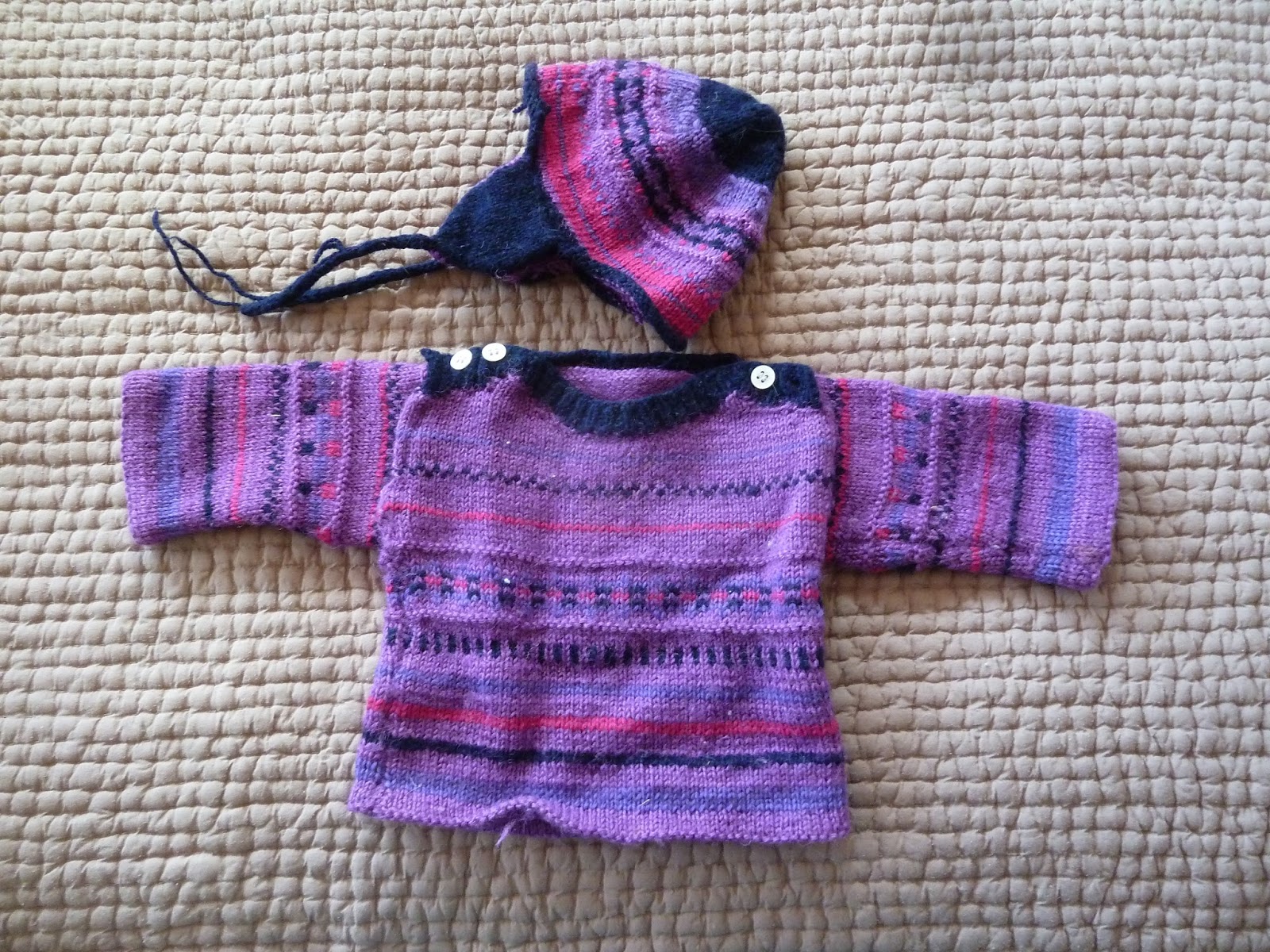
Now that I'm a grandma-to-be, I'm recycling the sweaters et alia designed and knitted for Son the First in 1979. Some moth-hole repair is warranted, but all things considered, they're in decent shape.


Catch my posts on KNITTED TOYS on the Lion Brand Blog starting on Monday August 12th! (Yes, I am behind the times, as always....)

Thursday, August 8, 2013

Summer reading that lasts all year

Reading Knitologie by Lucy Main Tweet (Glitterati, 2012) is like listening to a thoughtful, interesting  friend who happens to knit really well. Written in a cordial manner that blends personal narrative with lucid directions, it's the kind of book that gives you ideas by the armful, many of which are incidental to the book's principal topic--how to incorporate alphabet letters into handknits--but all of which are absorbing, practicable, and life-enhancing.


For example, some of Ms. Tweet's good ideas are about basic, knitting-worthy colors--she favors blue and white, blue and yellow, certain neutrals--that work well with almost anything and provide a canvas for the imagination. It's a relief to find someone who isn't obsessed with black, tangerine tango, or kelly green.  She also has great ideas about storing yarn oddments and ball bands (in glass jars, so they're visual incentives).

Then there are the clear graphs of letters you can knit, plus a couple of icons, a paw print (inspired by the author's Coton de Tulear) and a heart. While many people could graph their own alphabet, how nice that these are already charted, saving knitters valuable time! Most of the photos show these letters in monochromatic designs, an embossed or damask effect, but a few are in contrasting colors, and those letters really pop. Since some of the patterns are for useful kid items, like scarves, caps, and mittens, I'd prefer to go the CC route, so garments can be quickly identified when rummaging through the nursery school Lost-and-Found box.

The book itself is beautiful, thanks to the teamwork of Ms. Tweet and the book's designer/principal photographer, Sarah Morgan Karp. It says something good about the publishing company--Glitterati--that they'd encourage such close collaboration, and that's one of the reasons the book is distinctive. The layout of letter charts, pages for notes, the patterns themselves which showcase the letters, even a clever integrated ribbon bookmark--all express the care and attention that distinguish a fine book from one that is merely packaged.

One last point--by focusing on the knitting of integrated letters, Knitologie delivers what it promises; that is quite satisfying.  Many knitting books covering a lot of material end up being uneven in content and technical advice.  Knitologie suggests a range of possibilities, offering, as it does, a basic tool kit rather than a project-based format.  Its pattern options, like pillows and mittens, have the dual purpose of teaching a knitter to do the basic work, and making her aware that that she can transfer the technique to her own designs.


P.S.  I almost forgot to mention that Lucy Main Tweet lives in Massachusetts. Hurray, New England!

Thursday, July 18, 2013

Flat as a cat on a mat....

Gentle knitters,
Several have inquired about the recent paucity of postings. Two words, my friends: summer heat. Because of this it takes most of my energy to move from one knitting project to another, distributed as they are in various regions of my house. This, despite a/c!  All of us in my bailiwick have been not merely flattened, but rather, squashed.

Flat Cat on Mat #1

Flat Cat on Mat #2
There have been two consecutive heat waves since the Fourth of July, meaning temperatures have been above 90 degrees F for more than three days running. However, if the temperatures are in the high 80s, which they sometimes have also been, and the humidity has been consistently in the jungle range, it feels like a heat wave anyway, even if it's not technically that. New England has been clobbered throughout July by the muggiest of muggy hot weather, the proverbial HHH.

Well, enough of this kvetching...

A frequent topic of knitting lit-rit-choor in the summer months is what one knits when it's hot outside. Since I've already weighed in on that with a recent article ("Stitch and Seed: Summer's Bounties," Knitscene Magazine, Summer 2011, 8-11) I shall say that to the predictable small wearable projects generally favored in this season, I have added stuffed animals. That's because I'll become a grandmama in a few months, and as I saved most of the sweaters I knitted for my own children when they were wee, there's no compelling need to augment the supply for a new grandson who will inherit (and I hope wear) the exact same garments as his father. But hand-knitted stuffies?  Well, that's a brave new world to conquer.

 More on this engaging topic shall be forthcoming, but at the moment I must cease and desist, or melt.

Alfie flees the knitted hedgehog!


Tuesday, July 2, 2013

Yarn porn

Credit:  Carolyn Morgan

Beauteous hand-dyes recently espied at a farmers' market in Bath, Maine.


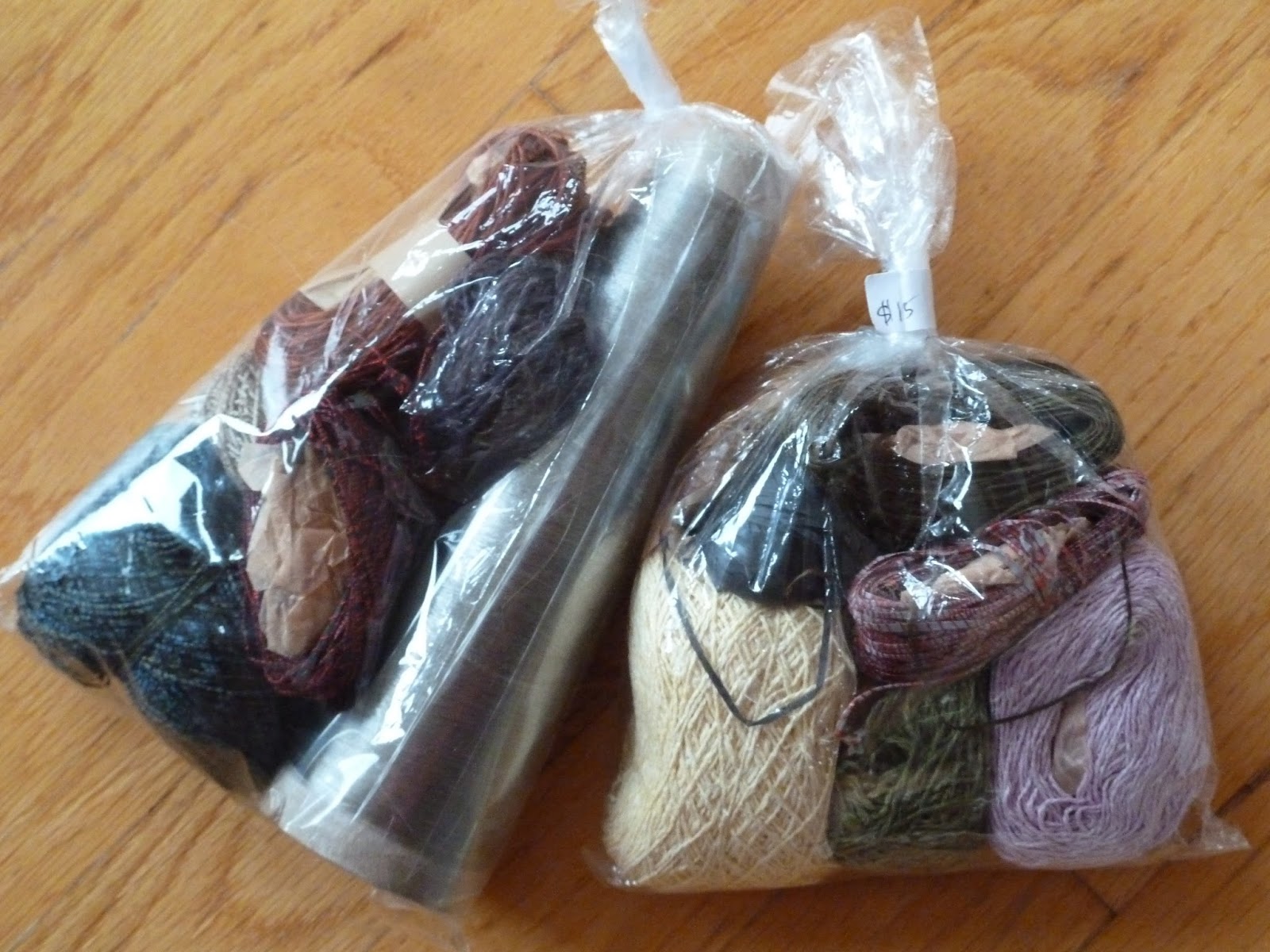
Mixed bags discovered at Habu Textiles, NYC. These most interesting yarns include silk-wrapped paper, cashmere and silk blends, cotton and silk blends, and a small cone of metallic something or other.


Molly dubiously assesses coral cashmere and ivory silk purchased at School Products Yarns, NYC.

Monday, June 17, 2013

If a tree falls in a forest and no one is around...


So, I knitted a blanket for my friend Florina's son, due to appear in October 2013.  The Baby Shane blanket pattern, by Tanis Fiber Arts, is one of my favorites, and among the yarns I used (for the red and butter-yellow stripes) were Rowan Pure Wool Aran (yellow) and Classic Elite's Waterspun, (production discontinued), in an iodine red. I washed the blanket in Woolite in icy cold water, without agitation, and rinsed it in icy cold water, without agitation.  After draining the tub and rolling the blanket in a series of towels to absorb the moisture, I was horrified to discover that some of the red dye had bled onto the yellow yarn.


The Knitting Goddess, whom I consulted, said, "That's why you should always make a swatch." She did some research and found a product called Carbona Color Run Remover that sucks up "fugitive" dye. I did some research and discovered Carbona for sale at a nearby Walmart. I drove to Walmart.

Entering Walmart was almost as dismaying as discovering the dye damage. Why is it that the killer shark theme from "Jaws" starts to pound in my brain the minute I set foot in there? Why does everyone inside that big concrete box look like an inmate of a halfway house? Why did I have to walk the entire six mile length of the store before I could locate the laundry products aisle? Is it possible that some people are born knowing how to navigate a Walmart, or is this a new field of academic research?

At long last I found the product, purchased it, and discovered, on reading the box at home that it works only in "the hottest water permitted by the fabric care label."

Neuroknitter thought I might be able to wash the blanket in hot water if I didn't agitate it. I called the toll-free phone number on the Carbona box and got a recording that said the office was closed, and if I had ingested Carbona I should immediately call a Poison Control center.


I discussed this with H, who, under torture, will confess that he holds a doctorate in chemistry. He examined the list of Carbona's ingredients. Then he said, "I think you should knit a swatch with those yarns, wash the swatch as you did the blanket, then, when the dye runs, try the Carbona in hot water and see what happens. But if you ask me, I think the blanket really looks okay, and Florina and her baby won't notice."


I knitted a swatch a couple of evenings ago, during the CBS news, local and national. I measured the swatch prior to washing.


I washed the swatch exactly as I'd washed the blanket. Guess what? The dye didn't run.


My laboratory.


The testing ground and materials.


Woolite added to icy cold water begins to foam as they mix.

Swatch immersed in Woolite and icy cold water.


Swatch after rinsing and drying. No runs. No significant shrinkage either.

H told me that I needed to repeat the experiment until the dye ran, so I could see if Carbona and very hot water removed the color run without shrinking the blanket. I repeated the experiment.


The dye, as you can see, still didn't run.


H again opined that neither Florina nor baby would notice anything amiss. My friend Maa-gret said the effect was like a madras fabric. It looked like it was meant to be that way. Meanwhile I was thinking, suppose I do wash the blanket in Carbona and the dye comes out and the blanket doesn't shrink. That would seem the best possible result, but...did I really want a newborn to be wrapped in a chemically-treated blanket?


I showed the blanket to the Knitting Goddess, who told me that the dye must have run because the yarn was "crocked.


The Free Dictionary (http://www.thefreedictionary.com/crock) says this is a term originating in New England [possibly because of New England's historic and role in the U.S. textile industry?] meaning


v. crockedcrock·ingcrocks
v.tr.
To soil with or as if with crock.
v.intr.
To give off soot or color.


The Knitting Goddess said, "Really, it looks fine.  No one will notice the bleed."

If no one notices, then maybe the dye didn't run after all? Just like the tree in the forest, which, when no one is around, falls ever so silently...?


Thursday, June 13, 2013

Celebrating World Wide Knit in Public week


Neuro and I met at New London's Bean and Leaf Café, whose iced coffee I highly recommend, last week.  Neuro brought along a pair of beauteous gray socks she made for her dad for Father's Day, and was working on a shawl variant of the Clapotis (can't remember the exact title, but perhaps she will comment with the proper info) using a yarn she'd dyed herself in an inimitable yellow and gray colorway.  In the foreground please notice the baby blanket I recently completed and washed, only to discover that the red dye ran onto some of the yellow stripes.  This tale of disaster, with perhaps a  happier ending, will be related at length in a future post.